Ask an employer why they rejected their last hundred candidates.
Their systems were never built to answer.
Volumes multiplied, AI polished every CV, and tools built for a slower market can no longer tell
candidates apart, while hiring has never carried more strategic weight.
The job market needs new infrastructure, built on signals that can be trusted and verified:
skills and capabilities.
Everyone says they hire on skills. Almost no one can show it.
85%of employers say they hire on skillsTestGorilla · State of Skills-Based Hiring
1 in 700hires actually changed as a resultHarvard Business School × Burning Glass Institute
The intent is real. The evidence is missing. Nothing in the market produces the record
that would make a skills-based decision provable, so hiring falls back on the CV, the school, the name.
The infrastructure
Verified skills enable data-driven hiring.
01Skills ontologythe foundation
Two people describe the same ability in ten ways; a job advert in ten more. 13,900 standardised
skills give them one set of terms, and the ontology maps onto whichever reference the client
already uses: ESCO in Europe, a national framework in the Gulf, an employer's own grid. Without that
mapping, nothing above can be compared.
13,900 skillsmaps to ESCO and national frameworksone term, one meaning
02Verificationmachine
Every level is earned, never declared. Requirements are read twice, by independent
passes, before they count. Levels come only from supervised work: a live machine-led interview, a timed
test, code that ran. An unsupervised test proves nothing, so every assessment runs with anti-fraud
monitoring built in.
With a shared definition of what makes a great fit, and scores based on real, anti-cheat assessments,
recruiters make the right data-backed hiring decisions. And they have the record to prove it.
Ninety days after each hire, we learn whether the decision held, and the system adjusts what it weighs.
The more it is used, the better it gets.
The product
The product, as a recruiter sees it.
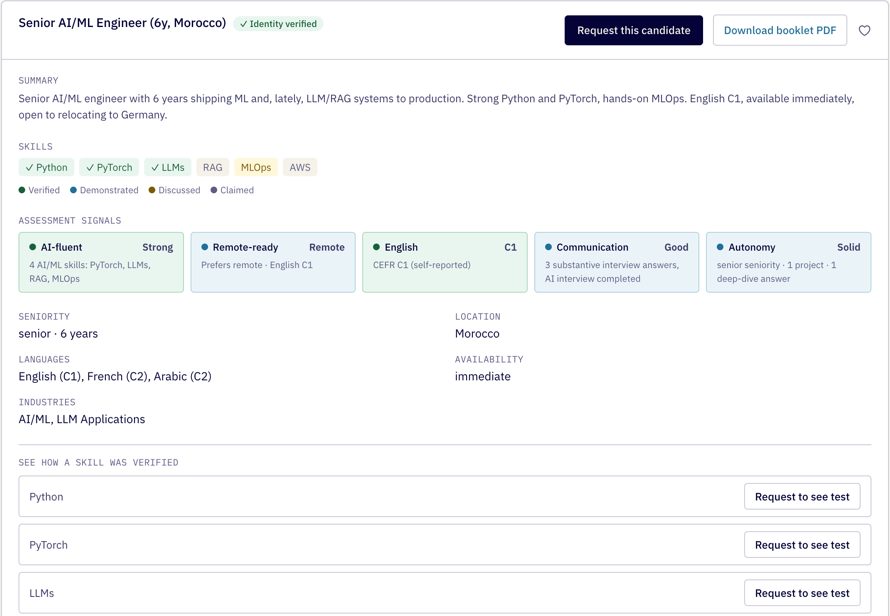
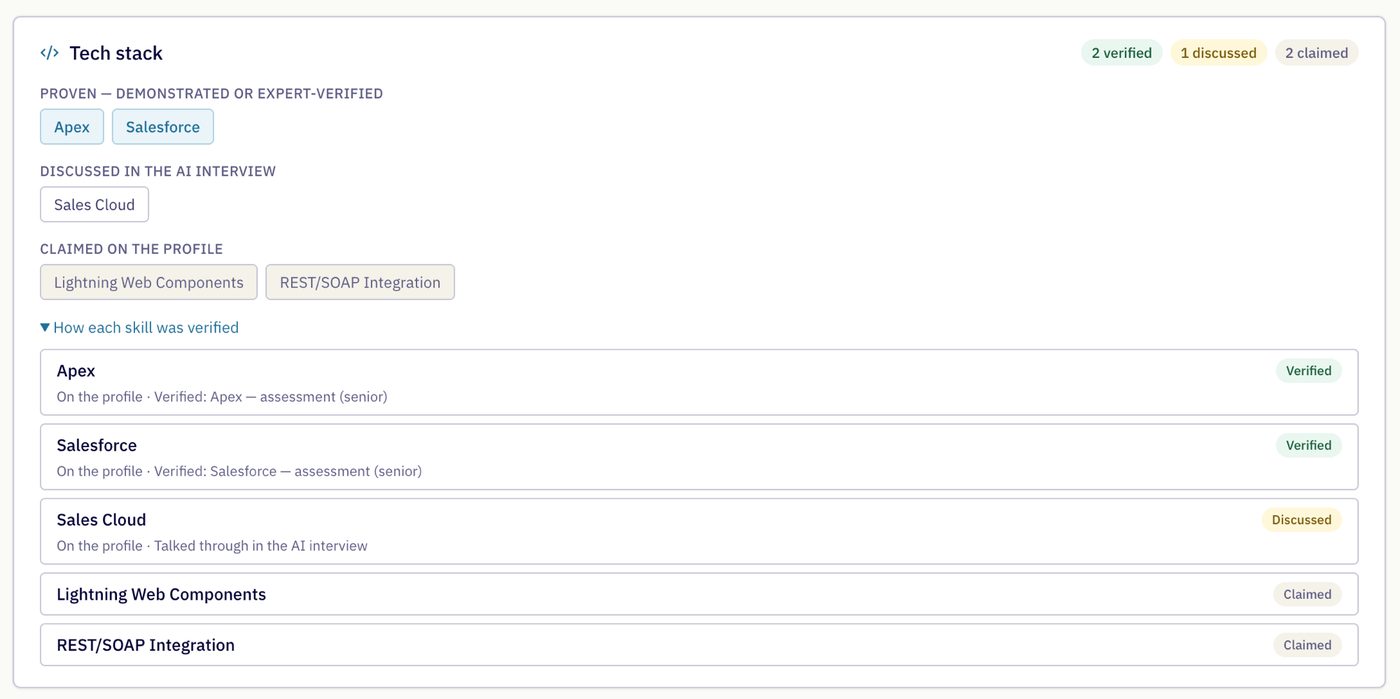
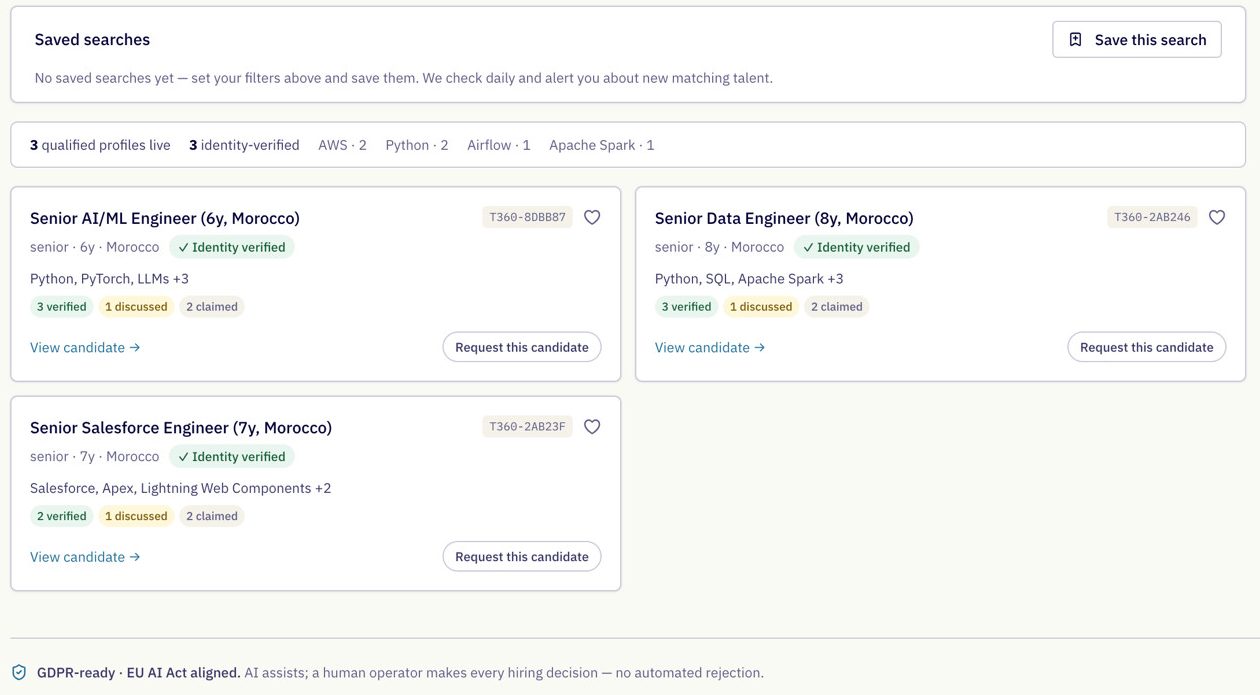
The booklet: skills with their level, the assessment signals, and how each one was verified.See how a skill was verified: proven, discussed and claimed, each with the test behind it.The shortlist: identity-verified candidates, with the evidence count attached to each.
What changes, and for whom
Visible Candidates. Augmented Recruiters. Hires that hold.
AI does the reading, the interviewing and the grading. The ranking is not AI,
it follows rules a person can read, which is why every decision can be opened and explained.
01 · Calibration and sourcing
Requirements are read across eight sources and mapped
to the ontology, with a second pass checking the first. Candidates are matched against the verified pool
and the gaps are named.
02 · Assessment
A conversation in natural language, not a form: a real-time voice
interview, timed tests, code, anti-fraud. Levels come out earned.
03 · Scoring and engagement
Explainable weights, a publication threshold, a full log.
The recruiter receives a pipeline they can work: prioritised, data-backed, manageable.
What leaves the recruiter's week
Reading three hundred CVs to find ten · building and tuning a test for every role · justifying a rejection from memory.
Where it sits
Built API-first to sit beside the HR systems already in place, rather than replace them.
What hiring at scale should feel like
Precise hiring, at high volumes, without the usual hassle.
Volume stops costing quality
Every applicant is assessed the same way, at any number,
and the shortlist arrives ready to work.
Every choice can be defended
To the ministry, to the board, to the candidate who was
turned down: criteria, levels and evidence attached to the decision.
It improves cohort after cohort
What happened to the last hires corrects what the
engine weighs on the next role.
Quality of hire at 90 daysstill in role, and rated by the hiring manager
Time to a workable shortlistfrom the day the role opens
Cost per qualified hireall sourcing and assessment included
Decision coverageshare of hires with a complete, replayable record, held to 100%
Baselines are set with each client on the first cohort, and we report against them every
cohort after that. Market evidence points the same way: skills-based search is linked to +12% quality of hire,
and skills-based hiring to +10 points of retention.
Who buys, and why now
Companies where a bad hire actually costs something.
They are growing fast
Headcount doubling, roles opening faster than anyone can screen.
Volume arrives before process does, and quality is what gives way first.
The role itself is unforgiving
Client-facing, regulated, technical, safety-critical.
One wrong hire is not a line in a spreadsheet: it is a lost account, an incident, a team that stalls.
The law is watching
National employment quotas turn a hiring shortfall into a penalty,
and every decision into something that may have to be explained.
Why we start in the Gulf
On the region's largest job site, 17.4 million applications chased 65,900 open roles last year.
Agency fees already take 20 to 33% of a first-year salary. That is the budget we come to capture.
Abu Dhabi is where those employers are.
Where we sit
An AI-powered hiring system that gets better with every hire.
Employment administrationPayroll, contracts, complianceWhere we differThey begin once the hire is made. We produce the decision that makes it.RelationshipPartner. We hand the hire over; they run the contract.
Skills assessment platformsPoint-in-time testingWhere we differThey score a candidate on the day. We carry what happens at ninety days.RelationshipHead on. The ninety-day record is the asset a test alone cannot produce.
Agencies and search firmsRelationships and judgementWhere we differThe consultant's reasoning leaves with the consultant. Ours stays in the system.RelationshipChannel. We sharpen their shortlist; they bring us volume.
We were the customer
We ran our own hiring on one of these platforms and stopped using it.
That failure is the specification we built against.
Business model
USD 3,600 a year, whatever the salary.
TeamUSD 3,600 / yearOne hiring team, three campaigns included. The market charges USD 60 to 100 per recruiter per month;
we charge that for the whole team.
Additional campaignUSD 750 / campaignA campaign is the unit of value: one role opened, sourced, assessed, ranked and recorded.
Never a share of the salary.
Enterprisefrom USD 15,000 / yearLarge accounts: delivery run alongside them, our ontology mapped onto their own grid, service levels.
A Gulf agency charges the employer 20 to 33% of a first annual salary, per hire.
Arkemys is flat, per team, whatever the salary.
Track record
We built this out of the work, in that order.
We designed and delivered Morocco's national upskilling programme in tech.
A thousand people trained and placed across Casablanca and Rabat on JobInTech.
We worked hand in hand with the most demanding IT recruiters.
The multinationals whose standards decide whether a candidate is taken seriously anywhere else.
Then we became our own first customer, running this exact process.
The ontology, the supervised assessments, the ranking a recruiter can defend, the record of what happened
next: each part was built because the work demanded it, and used on our own hiring before it was offered
to anyone.
88%into a job, across 1,800+ people trained
120+recruiters and employers worked with
2 yearsrunning it on our own hiring before selling it
Founders
Two people who have already sold to, and built for, this exact buyer.
Fifteen years selling to the buyer we are pricing for. Global offshoring and IT services
companies; their hiring pressure is the one Arkemys is built around.
Built and ran the funnel this product encodes. 1,800+ trained, 88% into work,
120+ employers, and Morocco's national upskilling programme delivered end to end.
HEC Paris and the Sorbonne, fifteen years inside the public and institutional side
of employment.
Built the platform end to end, from idea to running system. Skills ontology across
13,900 skills, anti-cheat assessments, AI interviews, explainable ranking.
Engineers the cost, not just the feature. Assessment infrastructure designed to stay
cheap at volume.
Came from the candidate side. Founded a technical community of 3,000+ engineers,
ran 70+ events, then recruited 100 qualified candidates in 48 hours through it.
Between us we have stood on both sides of this transaction: the employer who cannot verify
a claim, and the candidate no one will believe. Arkemys is the thing we each needed and could not buy.